It’s done. At last. just a few i’s to dot and t’s to cross. But it is now bookable from the 25th July onwards. and, Yes, for those who have been following the (lack of) progress, we do mean this year – 2025!!
Full details are on the Treehouse page under SPACES But here is a little (ahem!! actually rather long) treatise on the nature of treehouses. It was written for entering the Treehouse into the RIBA Small Projects award and explains why a treehouse can (and really should) sit firmly on the ground. … so boil a kettle and let’s begin…
THE DEFINITIVE TREEHOUSE?
There is no definitive idea about what does, or does not, constitute a treehouse.
It may sound obvious but the clue is in the title. A treehouse must be about the trees. It could be
in the trees, on the trees or around them. The trees could be inside the treehouse or even on the
treehouse. Whichever way it is, the treehouse should construct a meaningful dialogue with an
individual tree or, even, an entire forest. Ultimately, the treehouse should be the interface that
communicates some greater truth about the nature of trees to us, the human visitor.
In its most basic form the treehouse will normally be located high up or at least give the
impression of height, providing a lofty, woody experience. And that, sadly, is where most treehouses stop.
For us it seems more complex. There are multiple opportunities for any treehouse to engage with
trees and develop a relationship with the environment that surrounds it. Our aim is to find a way
to express that in built form so the treehouse can openly communicate and, in turn, display that
relationship for the visitor. We see the house as a bridge that links the woody world to the human
one, interpreting each one for the other.
In order to build a house that does that – in all its many aspects – we have to learn to think like the
trees, to extract the essence of the forest and to build it into the house. By doing so, we hope to
create a vibrant connection that will produce a closer, more insightful experience of ‘tree-ness’
than can be found in any other place.
The process of making that happen in the case of our own Zero Zero Treehouse has been long
and tortuous!
ELEMENTS
The only thing everyone agrees on is that a treehouse has to have some element of height. The
easiest way to achieve that is either to fix it directly up onto a tree or, as is more often the case
these days, position it on stilts next to a tree.
In these times of environmental issues and sustainable ambitions you have to ask whether it is
justifiable, or responsible, to simply plant a house on top of a tree where it will sit like some sort of
tumorous graft!
Aside from any philosophical considerations, actually building on the tree has practical
implications. There are obvious weather sealing issues, there are weight considerations,
problems with toilets and flexible plumbing and of balance when filling a bath with half a ton of
water – or more. Is it reasonable to expect the tree to absorb it all?
Our own 30m high Black Walnut tree moves with the weather and the upper trunk sways up to 2
metres in a big storm. Not only would it be deeply uncomfortable in a storm, and definitely not
safe, but changes to the loading would inevitably affect the development of the tree itself as it
struggles to adapt. Movement is critical to the development of a tree, its trunk and its roots. To
interfere with that seems rash, at best.
At first glance joining one tree to another, might also seem reasonable. It would share out the
extra weight, restrict the range of movement and allow one to gain strength from another. But
that introduces a series of unknowns and conflicts, that impact on a wide range of subtle and
nuanced characteristics within the structure of each tree as their differing movement parameters
become conflated and confined.
Changes like this alter the way in which the trees exist as independent entities and have far
reaching consequences for their ability to move, to sway, to grow up, to grow out and, ultimately,
to grow old. And what if one tree were to die before the other? It conjures up ghastly images of a separation of
artificially conjoined Frankensteinian twins.
ASSAULT
The next issue is attachment. To attach directly to a tree is to physically attack it. The act of
piercing the bark and driving in steel pins to support the considerable weight of a treehouse
structure, and its occupants, needs solid long lasting materials and life long maintenance and
attention. They say any damage inflicted by steel pins driven into the ‘heartwood’ of a tree is
soon ‘healed’. But the very terminology says otherwise – for a tree to heal there has to be a
wound. The wound – into its ‘heart’ – will grow over as the tree tries to physically recover and
absorb the incursion.
That may be fine, but equally it may not. There are unknowns. What of the
intricate network of interconnectivity that underpins an entire woodland? What of the dialogue
between trees, that we don’t understand? How does the change in the pattern of one tree’s
movement affect it’s relationship with other trees and its place within the hierarchy of the forest?
There are tons of theories now about how trees communicate, how they coexist and how groups
of trees can act as a single organism. So to build things on them, or through them, or to join them
up, is to dabble with the unknown and interrupt a conversation in a language we don’t
understand. What is certain is that interventions like this increase the biological burden on the
tree and must impact on the course of the tree’s life.
Finally, is it likely that in the 200 to 400 year life cycle of a big tree that the treehouse will always
be there? Or will the intrusion be removed at some point, leaving the tree damaged, distorted
disadvantaged and vulnerable. Who can say?
The race is long and none of us will live to witness the finish!
THE SOLUTION.
We think to build successfully we have to think like the tree, to define its essence, to consider the
nature of a tree in its own right and to look at its construction as an entire, holistic process. We
need to look deep inside and inculcate ourselves into the community of trees that surrounds us.
The job is then to incorporate what we find into the one structure which effectively merges back
into the community of trees, reflects it unique sense of place and truly earns the title of
’Treehouse’ – rather than of “Migrant Hybrid Virus Grafted Into the Structural Rootstock of a
Disabled Host!”
THE PROCESS.
So that’s where we began. And the first consideration was provenance.
It was important for us that all the wood used to build the house would come from the trees
immediately around it and be processed at the mill just across the road, 200 meters away. The
timbers themselves had to be from here. They had to grow up here. They had to belong here.
Trees are tall. For us to communicate the sense of being a tree, there has to be, as we have said,
an element of elevation and verticality. The Zero Zero Treehouse now reaches up to a height of
11m. But we are surrounded on all sides by the grandees of an ancient forest who tower over us
at around 25-35m. So, whilst we are tall, we are not that tall and what we lack in stature, we have
to make up for in stealth. It means we need to act taller to feel tall enough!
Everything within the house relates to its verticality. Andrew Birds (even our architect is of the
trees!) refers to the design as a “representation of ‘The Vertical Forest’ where strong linear
elements reflect the profiles and proportions of the forest around it.” All around the structure,
everything – from the profile and proportion of the spaces themselves, to the supports, the doors,
the windows and the glass screens – is divided into tall rectilinear elements to emphasise the
notion of verticality.
BEING THERE
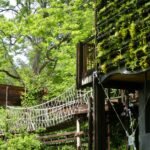
For you, the visitor, it begins on the approach. Two ramps rise up to an unnerving 4m drop
beneath an elevated rope bridge. There is a palpable sense of unease as the bridge itself sways
gently beneath your feet, marking the transition between your normal reality and our life of trees.
A forest of 63 multi-stemmed clusters of timber posts support the building in front of you which is
partly clad in Shu Sugi Ban, or Yakisugi, an ancient treatment of wood that scorches the surface
and protects it from fire, weather and decay.
Fire plays a critical role in renewing and refreshing the land, re-vitalising the flora and allowing the
forest to reform and redevelop in new ways. So from the outset, and throughout the interior of the
building, fire is ever present. The burning of the timbers represents an opportunity for our visitors
– the opportunity of a new perspective, new ambitions and new outlooks to explore. This is a
fresh start for weary travellers, a chance to take time out so they can return to the earthly world
with a renewed approach, renewed vision and renewed hope.
Back outside the burnt timbers that clad the building reach up and terminate in a wavy parapet at
the top. It mimics and reflects the varied skyline of individual trees and blends in with the drifting
profile of the wider forest itself.
But the Forest of Dean is about more than just the trees. A few metres below the surface, a coal
seam runs down the through the valley at an angle of about 8 degrees. For ten centuries
Freeminers of the Forest of Dean, have hewn coal under Royal Assent, from beneath the trees. It’s
a form of black gold that has powered the forest and provided for all the needs of the generations
of families that have worked the mines.
The external form of the treehouse leans into the rich visual tradition of the plethora of mine
workings which, to this day, are still dotted around the forest; rusty metal boxes stacked above
each other at different angles and makeshift workings connected by gantries that run into
mysterious doorways straight into the hillside and down into the ground.
The intersection and contrast of steel and timber also pays homage to the incredible efforts of
Robert Mushet adn his father David. In 1868, a mile down the forest track at Darkhill, Robert
refined the Bessemer process – which converts iron into steel – developing it into a reliable
industrial system to produce the first viable sheets of steel and high quality hardened steel. His
work revolutionised the progress of industrial metallurgy and without it we wouldn’t have been
able to build the house the way we have. So it is a constant reminder and memorial to his
contribution. These two considerations set us firmly within the historical and visual tradition of this
exact spot giving the building an authenticity and a right to be where it is.
Once inside, past the rusty steel tree sculpture that welcomes you in, there are real trees on view
at every angle, all framed in tall, glass and timber rectangles. This is nature as art. The forest
framed for our benefit. The views out reach into the depths of the beech wood that surrounds us,
and pierce through the trees, not with steel pins this time, but with highly focused shafts of
dappled sunlight.
UP ON THE ROOF
Early in the construction process, on arriving to inspect the trees, Adam, our tree surgeon, who
spends his life up in the high canopy, bounced onto the first floor deck.“Hang on a minute. “ he
said, looking around “This is at my height. This is where I live. This is my view!”
He spent time ensuring that the house and the trees around were are all safe, dancing across the
branches, cutting back dead wood here and loose boughs there that threatened to damage the
structure. He also left others to grow around the house, hugging it, coddling it in a familial
embrace so close that, when it’s windy, a few of them still gently tap on the side of the building.
It’s all part of the direct dialogue between us and the trees. On the one hand they reassert and
reinforce their own boundaries. On the other they reassure us that they are still there protecting us
from extreme events and supporting this stumpy upstart, the baby brother, that has suddenly
appeared in their midst.
There is a more sinister interpretation too – but that comes later.
At the heart of every tree is its central trunk – the supporting structure which holds it up. Its job is
to transport material and nutrients and to connect and communicate with all the various parts at
the different levels of the tree. At Zero Zero the staircase tower is that trunk. A solid timber core,
cut from huge chunks of Douglas Fir, it is encapsulated in a Corten steel skin that represents the
bark of a tree, both visually and symbolically. The tower interconnects the various parts,
organising transport throughout and conveying people up and down the treehouse. Cables and
pipes are concealed behind the outer layer, the technological ‘phloem’ that enables power and
water, the lifeblood of those who inhabit this space, to flow freely through the structure.
In the middle level is a library full of shelves and boxes. This is the repository of memory – the
thinking part of the treehouse – the brain. Our treehouse is still young so, like that of a small child,
many of the boxes are still empty. The spaces are designed to change and to fill up over the years
as people contribute meaningfully and thoughtfully to their contents. The records here are both
digital and analogue but also sensory. 40 films relating to forests – from Bambi to Sleepy Hollow –
sit alongside 50 books – The Jungle Book to The Secret Life Of Plants – amidst the beginnings of
a rotating display of forest related puzzles and art that echoes throughout the building. These
combined accounts, in whatever media, represent the many aspects of our human experience of
trees and the forest. It is the knowledge bank, the Haynes Manual, that we, visitors in an alien
world, can refer to and rely on to interpret and encourage our understanding of the woods around
us.
As the contents of this room develop and grow, its references will become wider and more
mature. At the moment a displaced Teddy Bear from an unknown child of a guest – who for all
we know may still bemoan its fate – sits in one small box, pondering the complexity of life around
it and wondering when its owners may return to collect it. Or more likely, where and at what time
is the picnic – should he decide to Go Down To The Woods Today!
His silent gaze and unwavering demeanour also serve to remind us that we are still far removed
from what goes on in the silence within the life of the things that surround us.
Just next door, along a short corridor lined with birch trunks, a secrete cupboard gives access to
an inside-out world for a triplet of tree based bunk beds. The Trunk Room, as it is known,
occupies an imaginary space in a graphical woodland where boundaries are blurred, caught
between the outside looking in and the inside looking out. It’s a cross between Neverland and
Narnia where dreams are real and children drift off beneath a skylight that entices them on a
journey towards the ‘second star on the left and straight on till morning’.
Beneath all this confusion, at the bottom of the treehouse, its roots reach out towards a body of
water in a pond which flows freely over the edges in a small rill. It trickles and seeps through the
moss border that grows along the edge and into the ground below before travelling up to a water
garden on the roof and then back down. Along the way it nourishes the thriving life of a green
wall that, as on any other tree, grows up and down the external face of the building.
At the canopy level the roof garden and trellis will develop over the coming years into an over-
storey of its own, draped in grapevines and covered in bergamot, clematis and passion flower,
blossoming together amidst the branches that extend over the boundary from the trees next door.
On sunny days people will recline on the deck here, in the full sun, amongst the foliage, gently
perspiring – transpiring even – under a soft mist that sprays from tiny jets below the vines.
Further away, deeper into the wood, the wavy profile, the sea of posts and the burnt timber
cladding can be viewed from a distance, all helping the treehouse to blend in, to become a
seamless addition in the heart of the forest. Where the building faces the woods, twenty mirrors,
each 4m high, swathe the base of the treehouse in a glittering shawl, reflecting back an image of
yet more trees. From here this illusory forest appears to grow inside and through the body of the
treehouse itself. It’s a mirage that links the building back, inextricably, into the landscape,
subsuming it in a leafy apparition of complex forms where one is oddly indistinguishable from the
other. The effect is confusing, both visually and cerebrally. It’s almost as if the forest is claiming it
as its own – something that continues in other ways too.
THE FELLOWSHIP OF TREES
In spring each year, high winds blow through the tallest trees and cover the house in pollen and
flying seeds. It’s an inundation that continues through to, and reaches its peak in, the Autumn.
Travelling through the building, apples and pears ripen around the bridge, crab apples hang over
the balcony into the kitchen whilst, higher up, the forest reigns down beech nuts and acorns and
walnuts onto the roof.
Some might see this this a harvest of plenty, provided for our benefit by our mighty benevolent
neighbours. But that would be to misinterpret a more malign intent.
It is actually an assault; a biological war that has been raging for centuries between the species,
an invasion of opposing armies, each numbering in their thousands. They lay siege to our newly
claimed territory, attempting to take root, to rise up and to supplant or displace this strange new
sapling in their midst.
And with that maybe we really do enter another realm. It is as if the trees can actually see us. They
are targeting us and mounting an offensive against us. Zero Zero has mutated. It has become a
virtual species, a real ‘living’ thing and a tangible force to be reckoned with. It is one the other
trees are communicating with and doing battle with but ultimately, hopefully, one they will learn to
get along nicely with.
We Are Tree. !!!